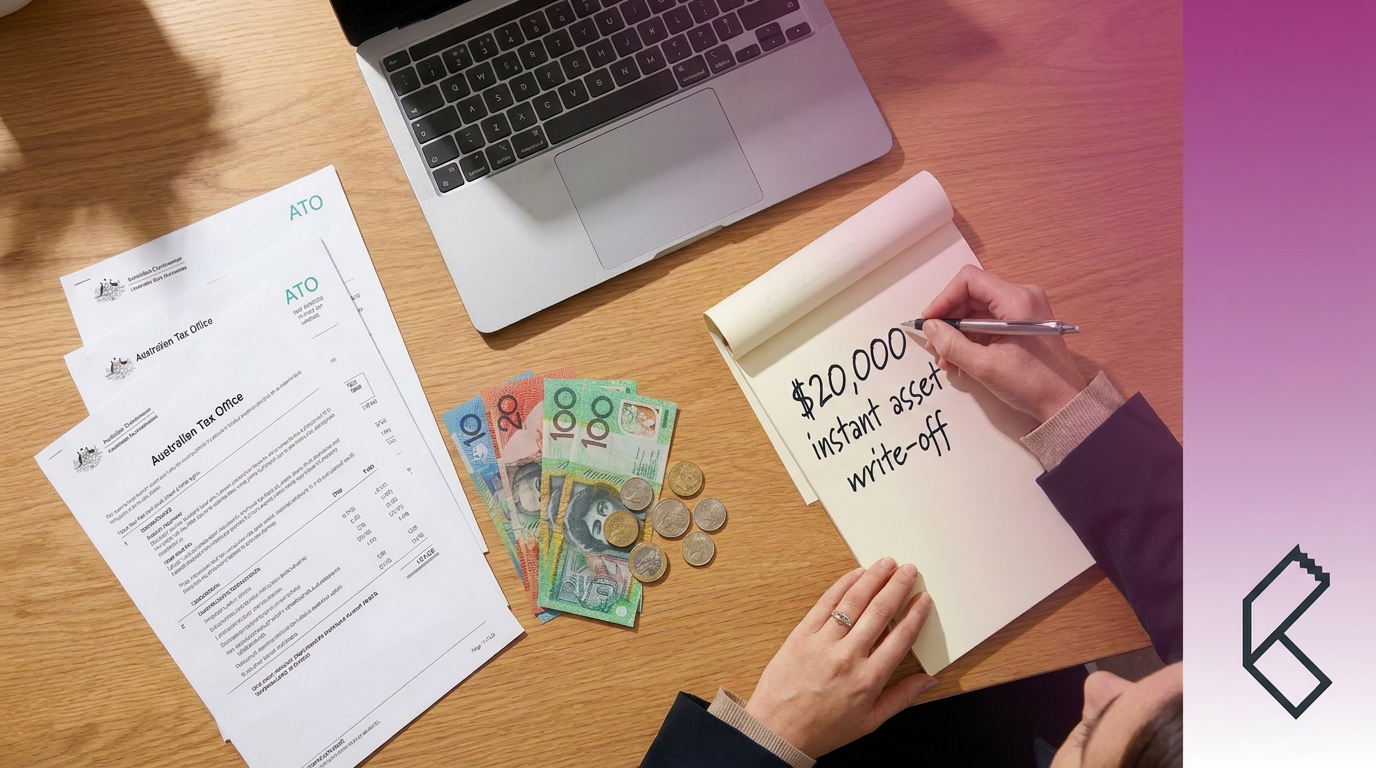
$20,000 instant asset write-off in Australia is set to become a permanent fixture for eligible small businesses from 1 July 2026, giving business owners greater certainty when planning investments.
At a high level, the rule allows businesses with turnover under $10 million to immediately deduct the full cost of eligible assets under $20,000, rather than depreciating them over time.
On the surface, it sounds simple—and beneficial.
But what we consistently see is this:
Many business owners misunderstand how to use it strategically. Instead of strengthening their financial position, they use it to justify unnecessary spending—especially around EOFY.
The Biggest Misconception: “It’s a Tax Saving Opportunity”
The most common mindset is:
“If I spend now, I’ll pay less tax.”
While technically correct, it misses a critical point. A deduction reduces your taxable income—it does not reimburse your spending.
For example:
- Spend $20,000
- Save approximately $5,000 in tax (depending on structure)
- Still $15,000 cash out of pocket
The purchase only makes sense if it improves your business—not just your tax position.
Why This Matters More in 2026
The environment for Australian small businesses has changed significantly.
Many businesses are currently dealing with:
- Rising operating costs
- Cash flow pressure
- Higher interest rates affecting borrowing costs
- Increased compliance obligations
These pressures are widely impacting SME cash flow and decision-making.
In this context, making large purchases purely for a deduction can:
- Reduce liquidity
- Create reliance on debt
- Limit flexibility in the months that follow
Tax timing should never come at the expense of financial stability.
Common Mistakes We See (and How to Avoid Them)
- Last-minute EOFY spending
Buying equipment or tools in June without proper planning is one of the biggest risks.
These decisions are often rushed and reactive, rather than aligned with long-term goals.
- Purchasing without a clear ROI
Not every asset improves performance. Before buying, ask:
- Will this save time?
- Increase revenue?
- Reduce errors or risks?
If the answer isn’t clear, the deduction alone isn’t enough.
- Overcommitting cash
Even if each asset is under $20,000, multiple purchases can quickly drain cash reserves.
A series of “small” decisions can create a significant financial impact.
How to Use the Write-Off the Right Way
The most effective approach is simple: Let the business need drive the decision—not the tax outcome.
Focus on operational improvement
The strongest investments tend to:
- Automate manual processes
- Improve reporting accuracy
- Increase capacity or efficiency
These are the areas where we see real long-term value.
Plan ahead—not at EOFY
Businesses that get the most benefit:
- Identify required investments earlier in the year
- Align purchases with cash flow forecasts
- Allow time for implementation and training
This turns the write-off into a strategic tool, rather than a last-minute trigger.
Maintain cash flow visibility
Having clear, up-to-date financials is critical.
Without visibility, it’s easy to:
- Overspend
- Misjudge affordability
- Create unnecessary pressure
That’s why strong bookkeeping and reporting systems make such a difference.
Where iKeep Fits In
At iKeep, we work closely with Australian small businesses to ensure financial decisions are based on clarity—not guesswork.
Our approach focuses on:
- Bookkeeping services that keep your numbers accurate and current
- Cash flow forecasting to support smarter timing decisions
- Payroll and BAS compliance support so obligations are always under control
- Clear monthly reporting to show what’s really happening in your business
When your financial systems are structured properly, decisions like asset purchases become easier—and less risky.
Instead of asking, “What can I write off?” You start asking, “What will actually improve my business?”
The Real Opportunity Behind the Rule
The biggest advantage of the $20,000 instant asset write-off isn’t the deduction itself.
It’s certainty.
With the rule set to continue, business owners can:
- Plan investments ahead of time
- Make more confident decisions
- Avoid the usual EOFY rush
That creates a shift from reactive to proactive financial management.
And that’s where real value lies.
Final Thought
The $20,000 instant asset write-off is a powerful tool—but only when used correctly.
If a purchase makes your business better, more efficient, or more profitable, the tax benefit is a bonus.
If not, it’s simply a costly decision with a small tax offset.
The difference comes down to clarity, planning, and having the right financial support in place.