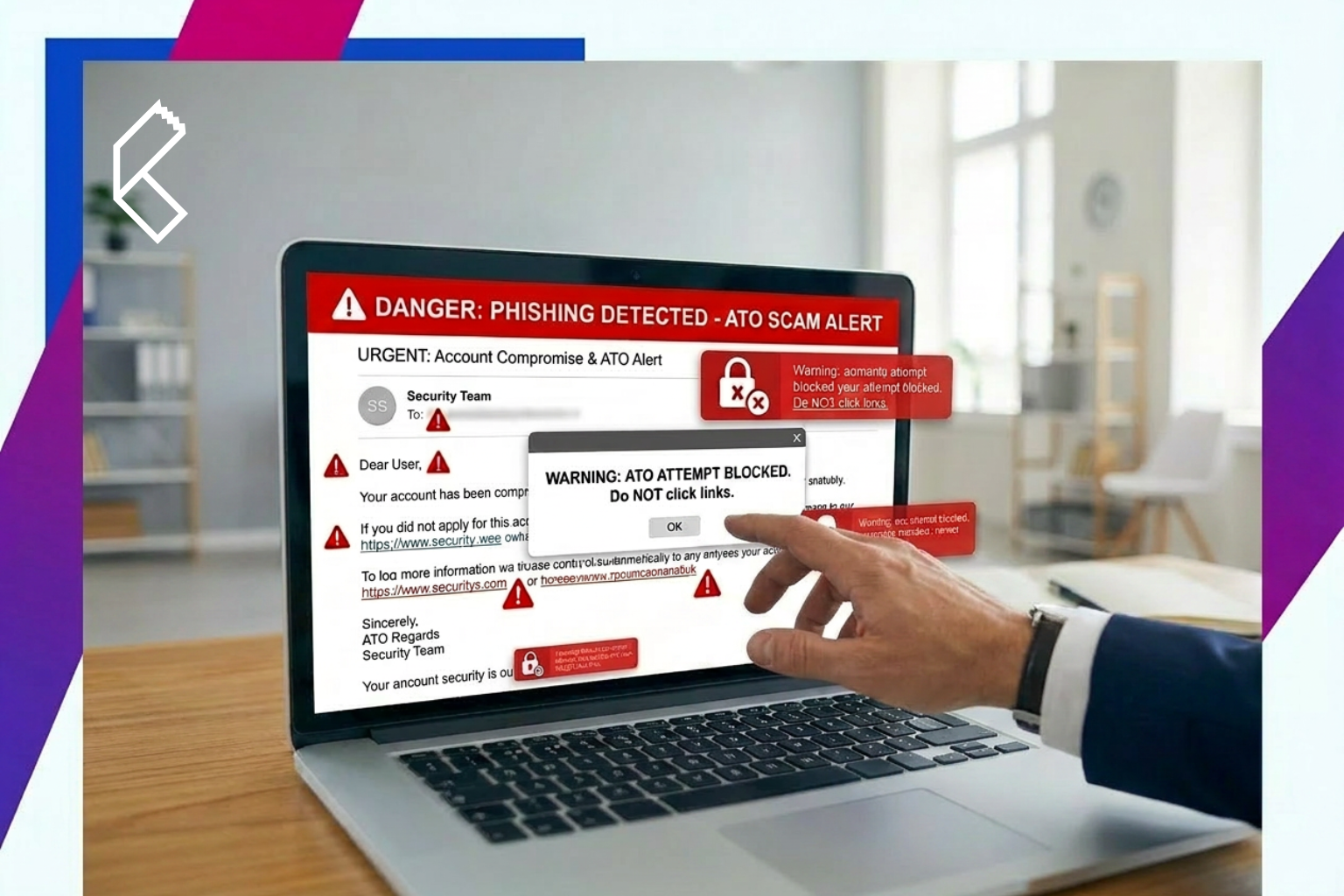
ATO impersonation scam activity increases sharply during tax time—and 2026 is no exception.
With EOFY approaching, scammers are becoming more targeted and more convincing, using emails, SMS messages, and phone calls that appear to come directly from the ATO or myGov.
Recent alerts include:
- A fake cryptocurrency declaration email pressuring recipients to act immediately
- A DocuSign-style “notice of assessment” scam linking to a fake myGov login page
Once access is gained, scammers can:
- Steal tax refunds
- Access your myGov account
- Redirect superannuation or business payments
- Use your identity for further fraud
For business owners, this isn’t just inconvenient—it’s a real financial risk.
Why EOFY is peak scam season
Scammers follow behavior—and EOFY is when businesses are most vulnerable.
During this time:
- Tax returns are being finalized
- ATO communications increase
- Refunds and payments are expected
This creates the perfect environment for scams to blend in with legitimate messages.
EOFY is widely recognized as a prime period for scams, especially impersonation of government agencies like the ATO.
Simply put: the more you expect legitimate messages, the easier it is for a fake one to slip through.
What the ATO will never do
Understanding how the ATO actually communicates is one of your strongest protections.
The ATO will never:
- Send unsolicited emails or SMS with links asking you to log in
- Ask for personal or financial details via email or text
- Threaten arrest, legal action, or immediate penalties
- Request payment via gift cards or cryptocurrency
- Ask you to disclose assets via an unexpected message
If a message includes any of these, treat it as a scam—no exceptions.
The red flags every business owner should know
Even with better technology, scams still follow predictable patterns. Watch for these warning signs:
Urgency and pressure
Messages that say:
- “Final notice”
- “Immediate action required”
- “Legal consequences if ignored”
These are designed to force a quick reaction.
Suspicious links or attachments
Scammers often direct you to:
- Fake myGov login pages
- Imitation ATO portals
Never log in through a link—always go directly to the official site.
Unexpected refunds or debts
You may see:
- “You’re owed a refund”
- “You have an outstanding tax debt”
Both are used to create urgency and trigger action.
Requests for sensitive data
The ATO will never ask for:
- Your myGov password
- TFN via email or SMS
- Bank details in response to a message
What to do if you receive a suspicious message
If something feels off, don’t engage.
Follow this process:
- Do not click links or open attachments
- Do not reply or provide any information
- Do not call numbers in the message
Instead:
- Call the ATO directly on 1800 008 540 to verify
- Forward suspicious emails to ReportScams@ato.gov.au
- Delete the message after reporting
Always use official contact details—not the ones provided in the message.
How iKeep helps protect your business
ATO impersonation scams aren’t just a cyber issue—they affect your finances, your compliance, and your peace of mind.
At iKeep, we help reduce risk by ensuring your systems are clear and controlled.
Through our:
- Bookkeeping services — keeping your data accurate and up to date
- Payroll management — ensuring structured, compliant processes
- BAS and reporting support — providing clarity over obligations
- Cash flow visibility — helping you spot unusual activity early
You gain confidence that:
- Your numbers are reliable
- Your systems are secure
- You’re not making decisions under pressure or uncertainty
And importantly—you have a team you can quickly check with before acting.
A simple rule to stay safe
If there’s one thing to remember, it’s this: If a message is pushing you to act quickly, it’s likely a scam.
Legitimate ATO communication:
- Is not rushed
- Is verifiable
- Directs you to secure channels like your myGov inbox
Taking a moment to verify can prevent serious financial damage.
Final thought
ATO impersonation scams are increasing—and they’re becoming harder to spot. But they still rely on:
- Urgency
- Confusion
- Distraction
The businesses that avoid them are the ones that:
- Slow down before responding
- Verify independently
- Maintain clear financial systems and support
As EOFY approaches, staying alert isn’t optional—it’s essential.