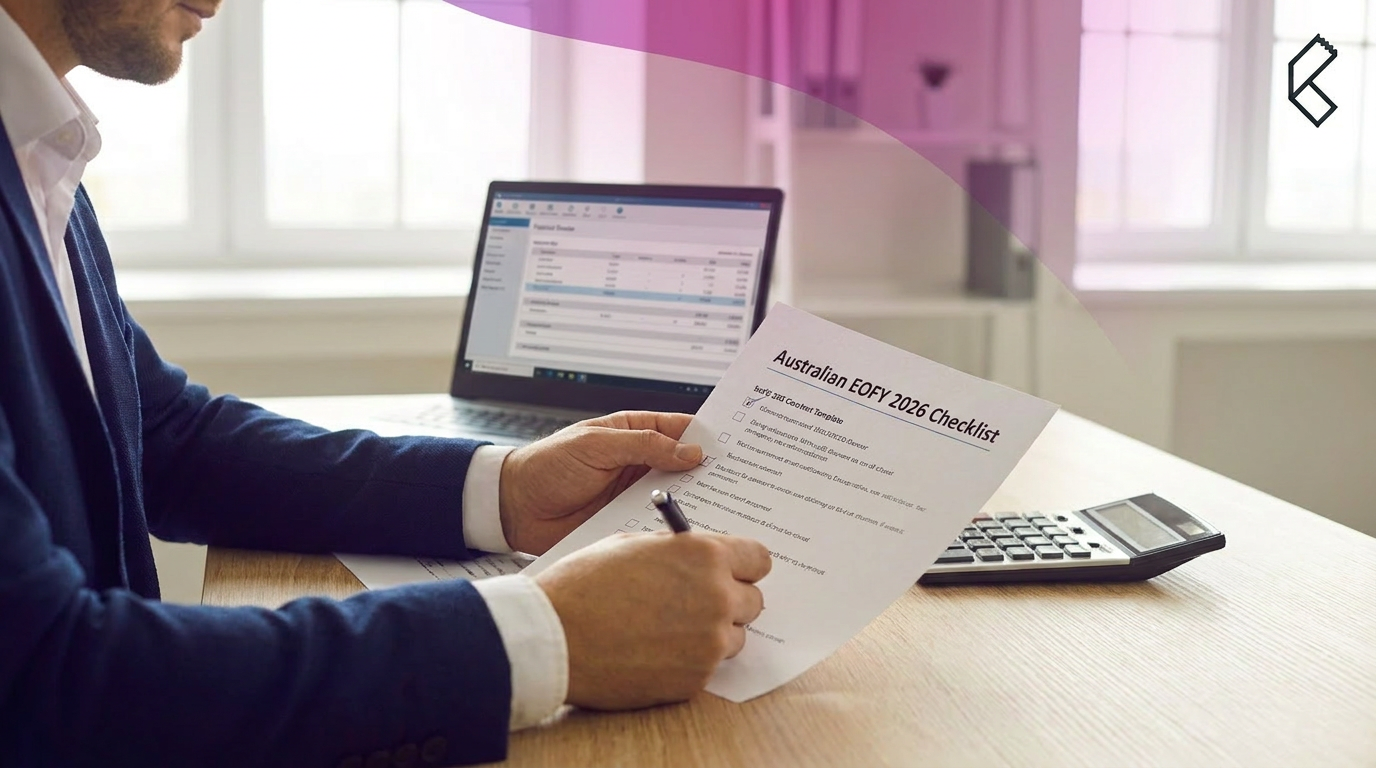
EOFY 2026 record keeping has become one of the most important business priorities for Australian SMEs in 2026. As the Australian Taxation Office (ATO) steps up efforts to recover more than $50 billion in unpaid tax, businesses with incomplete records, unreconciled accounts, or omitted income are increasingly finding themselves under the spotlight.
The days of sorting through a shoebox full of receipts at tax time are long gone. With the ATO now receiving real-time payroll data through Single Touch Payroll (STP) and using increasingly sophisticated data-matching technology, the gap between a missed obligation and an ATO notification has shrunk dramatically.
For business owners, EOFY isn’t just about lodging tax returns. It’s about protecting your business, reducing compliance risks, and ensuring you’re prepared if the ATO ever asks questions.
EOFY Record Keeping: Your First Line of Defense
Good record keeping is often viewed as an administrative burden, but in reality, it’s one of the strongest forms of risk management available to small businesses.
Accurate records help you:
- Meet your tax obligations confidently
- Support deductions and GST claims
- Track business performance
- Improve cash flow management
- Reduce the likelihood of ATO reviews or audits
- Make better financial decisions throughout the year
Poor record keeping, on the other hand, can result in penalties, interest charges, denied deductions, and unnecessary stress during tax season.
The good news is that a few simple EOFY habits can significantly improve your compliance position.
EOFY Checklist for Australian SMEs
As 30 June approaches, consider working through the following checklist.
- Move Away from Paper Records
If your business still relies on paper receipts, manual spreadsheets, or scattered records, now is the time to digitize. Cloud-based bookkeeping systems make it easier to:
- Store records securely
- Capture receipts instantly
- Access financial information from anywhere
- Prepare BAS and tax reporting more efficiently
Digital records also make it much easier to respond quickly if the ATO requests supporting documentation.
- Reconcile Your Accounts Before 30 June
One of the most common EOFY issues is unreconciled bank accounts. Before year-end, ensure that:
- Bank accounts are reconciled
- Credit card transactions are matched correctly
- Loan balances are updated
- Outstanding invoices are reviewed
- Payroll records align with accounting records
Regular reconciliation helps identify errors early and prevents surprises during tax preparation.
Businesses that maintain monthly reconciliations throughout the year often experience a much smoother EOFY process.
- Review Your Income Reporting
The ATO continues to focus heavily on omitted income. With data available from banks, payment platforms, employers, and government agencies, discrepancies are easier to detect than ever before. Take time to review:
- Sales records
- Online payment platforms
- Bank deposits
- Contractor income
- Interest and investment income connected to the business
Ensuring all income is correctly reported can help avoid future compliance issues and unexpected ATO correspondence.
- Separate Funds for GST and PAYG Withholding
Many small businesses run into difficulties because tax obligations become mixed with everyday operating cash. A practical strategy is to maintain separate bank accounts for:
- GST collected from customers
- PAYG withholding obligations
- Tax savings for future liabilities
By setting aside these funds as transactions occur, businesses can avoid cash flow shocks when BAS or tax payments become due.
This approach provides greater visibility and helps prevent accidental spending of funds that ultimately belong to the ATO.
- Review Payroll and STP Reporting
Payroll compliance remains a major focus area for regulators. Before EOFY, confirm that:
- Employee details are current
- Wages and superannuation have been recorded correctly
- STP reporting is accurate
- Payroll reconciles with your accounting system
Even minor payroll discrepancies can trigger questions or create additional work later.
An EOFY payroll review can help ensure your reporting obligations have been met correctly.
- Follow Up Outstanding Debtors
EOFY is also a good opportunity to improve cash flow. Review unpaid invoices and follow up overdue accounts where appropriate.
Recovering outstanding debts before year-end can strengthen your cash position and reduce financial pressure heading into the new financial year.
For many SMEs, cash flow challenges—not profitability—create the biggest operational risks.
- Seek Help Early if You Can’t Pay
One of the biggest mistakes businesses make is avoiding communication with the ATO when payment difficulties arise.
If you expect challenges meeting upcoming tax obligations, engage early.
The ATO is generally more receptive to businesses that proactively communicate and seek assistance before debts escalate.
Ignoring the issue often limits available options and can result in stronger recovery actions later.
Turn EOFY Into a Business Health Check
EOFY shouldn’t be viewed as a once-a-year compliance exercise. It can also serve as an opportunity to evaluate:
- Business profitability
- Cash flow performance
- Pricing strategies
- Staffing costs
- Growth opportunities
- Financial systems and processes
Many business owners discover valuable insights when they review their numbers properly rather than simply lodging returns and moving on.
Professional bookkeeping and advisory support can help transform EOFY from a stressful deadline into a strategic planning opportunity.
How iKeep Can Help
At iKeep, we help Australian businesses stay organized, compliant, and confident throughout the year—not just at EOFY.
Our team can assist with:
- Bookkeeping and transaction management
- Bank and account reconciliations
- Payroll and STP compliance
- BAS preparation and lodgments
- Cash flow management
- EOFY preparation and reporting
- Business advisory support
By maintaining accurate records year-round, businesses can reduce compliance risks, improve decision-making, and approach EOFY with confidence.
Final Thoughts
The ATO’s visibility into small business activity has never been greater. As data-matching programs expand and real-time reporting becomes standard, good record keeping is no longer optional—it is essential.
EOFY 2026 is the ideal time to strengthen your financial processes, tidy up your records, and address potential issues before they become costly problems.
Businesses that invest in strong EOFY record keeping are not only better prepared for tax time; they are also better positioned for growth, profitability, and long-term success.